

Charging piles are the core supporting facilities for new energy vehicles, and the selection needs to first anchor the application scenarios and core requirements. Different scenarios have significant differences in charging speed, power, installation conditions, and functional configurations. Priority should be given to using AC slow charging stations for household private parking scenarios, with a power of 7kW (220V) as the main power source. The installation is convenient, the cost is moderate, and it is suitable for long-term charging at night. It can be fully charged by inserting a gun before bedtime and waking up in the morning, perfectly matching the daily commuting needs of household cars. Commercial public scenarios such as shopping malls, highway service areas, and logistics parks require the selection of DC fast charging piles with a power coverage of 30kW-350kW. The vehicle can be charged to 80% in 15-30 minutes, meeting the operational needs of high turnover and short-term stay. For dedicated scenarios such as enterprise fleets and bus stations, 11kW-22kW AC piles or 60kW-120kW DC piles can be selected according to the vehicle type (logistics vehicles, buses), taking into account both batch charging efficiency and cost control.
Core parameter matching: power, voltage and vehicle adaptation
The charging power directly determines the charging efficiency and is the core indicator for selection. If the household scenario only supports 220V single-phase electricity, a 7kW AC pile is the optimal choice, suitable for the vast majority of household new energy vehicles, to avoid blindly purchasing 11kW piles and wasting success rates; If 380V three-phase electricity can be applied for, 11kW-22kW AC piles can shorten the charging time, suitable for multi car households. In commercial fast charging scenarios, the mainstream choice is 120kW DC piles, supporting 800V high-voltage platform models. It can travel 300km on a 10 minute charge, greatly improving the user experience; The supercharging station can use 160kW-240kW high-power DC piles, suitable for heavy-duty vehicles and high-end models. At the same time, it is necessary to confirm the maximum supported charging power of the vehicle to avoid the pile power far exceeding the vehicle's adaptation value, which may cause equipment cost waste.
Safety and Qualification: The Core Threshold of Quality Assurance
Safety is the primary prerequisite for selecting charging stations, and it is necessary to focus on verifying product qualifications and protective performance. Legitimate charging stations must comply with national standards such as GB/T 18487 and GB 39752, and key components must be certified to ensure electrical safety and communication stability. In terms of protection grade, the indoor installation must reach IP54, and the outdoor installation must reach IP55 and above. It is effective to prevent dust and water. In response to rainstorm, damp and other complex environments, coastal areas need to pay extra attention to salt spray prevention design. In northern low temperature areas, -30 ℃ low temperature start models are preferred. The safety protection function needs to be complete, with five core functions including overvoltage, overcurrent, leakage, lightning protection, and overheating protection. High end models can be equipped with ten layers of safety protection, which automatically shuts off when charging is abnormal, eliminating safety hazards.
Intelligent functions and operational requirements: adapting to different usage scenarios
Intelligent functions directly affect the convenience of use and operational management efficiency, and can be selected as needed to avoid redundant configurations. The basic functions of household scenarios can meet the needs, such as card swiping start, timed charging (off peak electricity consumption to save electricity costs), and remote monitoring of apps, without blindly following gimmicks such as facial recognition and voice control. In commercial operation scenarios, it is necessary to strengthen intelligent management capabilities, prioritize models that support 4G/Wi Fi networking and cloud management platforms, achieve user QR code payment, order management, billing settings, remote fault diagnosis, support multi pile cluster management, and reduce manual operation and maintenance costs. Some high-end models are equipped with dynamic load management function, which can adjust power in real time according to the grid capacity, avoid transformer overload, and adapt to scenarios with limited grid capacity such as residential areas and commercial districts.
Installation conditions and costs: consideration of cost-effectiveness throughout the entire lifecycle
Selection requires simultaneous evaluation of installation conditions and full lifecycle costs to avoid implicit expenses. Before installation, confirm the nature of the parking space (property/lease), property installation permit, meter capacity, and line distance. A 220V/32A meter is required for a household 7kW pile, and 380V industrial electricity is required for a DC pile. If the line distance is too long, it will increase cable costs. In terms of cost, the purchase cost of household communication poles is 2000-6000 yuan, which is easy to install and has low maintenance costs; The unit price of commercial DC piles is 100000 to 150000 yuan, but the daily service is 8-12 trips, and the cost can be recovered within 3-5 years. Priority should be given to brands that provide one-stop installation services and complete after-sales outlets to ensure standardized installation, timely fault response, and reduce post operation and maintenance risks.
CAMC Charging Pile Full Scenario Solution
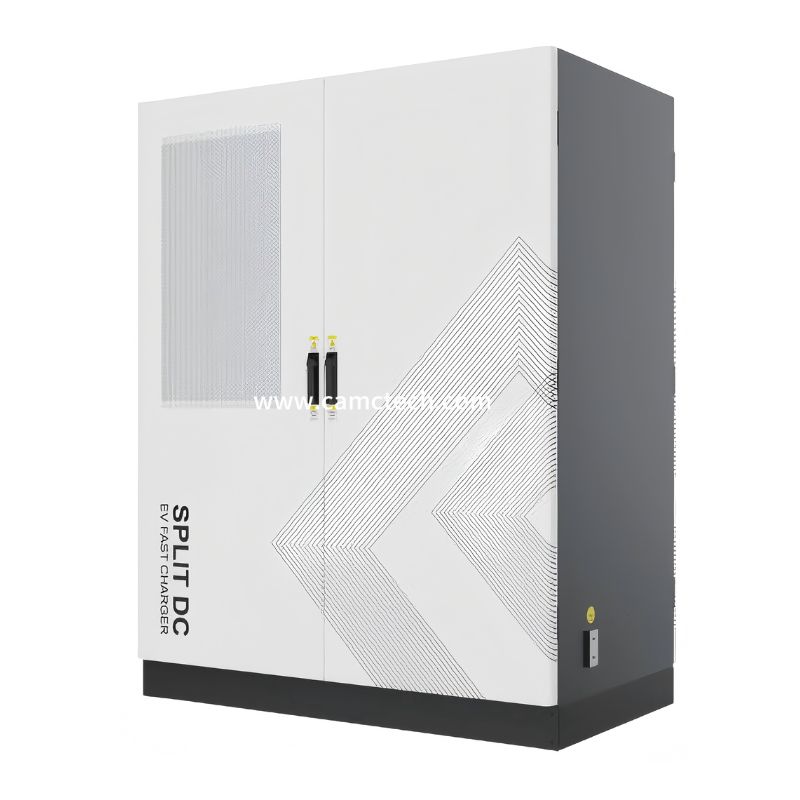
CAMC charging stations cover a full range of products including AC slow charging, DC fast charging, and high-power supercharging, catering to the needs of household, commercial, and dedicated scenarios. Household 7kW/11kW AC pile, IP55 protection, ten fold safety protection, supports APP remote control and timed charging, easy installation, stable and reliable; Commercial 120kW DC fast charging pile, compatible with mainstream vehicle models, can quickly charge 80% of the battery in 15 minutes, equipped with a cloud management platform to help commercial operations efficiently generate revenue; Specialized scenarios can customize high-power models ranging from 60kW to 240kW to meet the bulk charging needs of fleets and logistics parks, providing value-added services such as dynamic load management and intelligent cluster control. CAMC charging stations strictly follow national standards in production, with reliable quality of core components and a comprehensive after-sales guarantee system. They provide safe, efficient, and intelligent charging solutions for global users and are the preferred partner for new energy vehicle charging facilities.