

1、 Accurately match charging power based on fleet model size
Power selection is the core of fleet charging pile selection, which directly determines the energy replenishment efficiency and grid load, eliminating the "small horse pulling big car" or power waste. The small fleet mainly consists of electric delivery vehicles and light new energy trucks. The battery capacity of each vehicle is relatively small, and the demand for energy replenishment is mild. It is suitable for 120kW-180kW multi gun DC charging piles, supports multi vehicle time-sharing charging, and meets the daily short distance turnover energy replenishment needs. It is also suitable for the staggered charging mode at night in warehouses.
Medium to large logistics fleets and heavy truck transportation enterprises mainly use electric tractors and electric dump trucks, with large battery capacity and high endurance requirements. Therefore, it is necessary to choose high-power DC fast charging piles with a capacity of 320kW-480kW. This type of vehicle can meet the full day operating mileage with a single charge, and is suitable for the scenario of centralized batch energy replenishment after the fleet receives the vehicle. For large warehouses with a large number of vehicles and concentrated charging periods, flexible group charging equipment can be used to dynamically allocate power and avoid peak overload of the power grid caused by multiple vehicles charging at the same time, greatly improving equipment utilization.
2、 Distinguish the model structure and adapt to the layout of the warehouse site
The fleet warehouse site is divided into three scenarios: indoor enclosed warehouse, outdoor yard, and simple rain shelter. Each scenario corresponds to a dedicated aircraft model, taking into account space utilization and equipment stability.
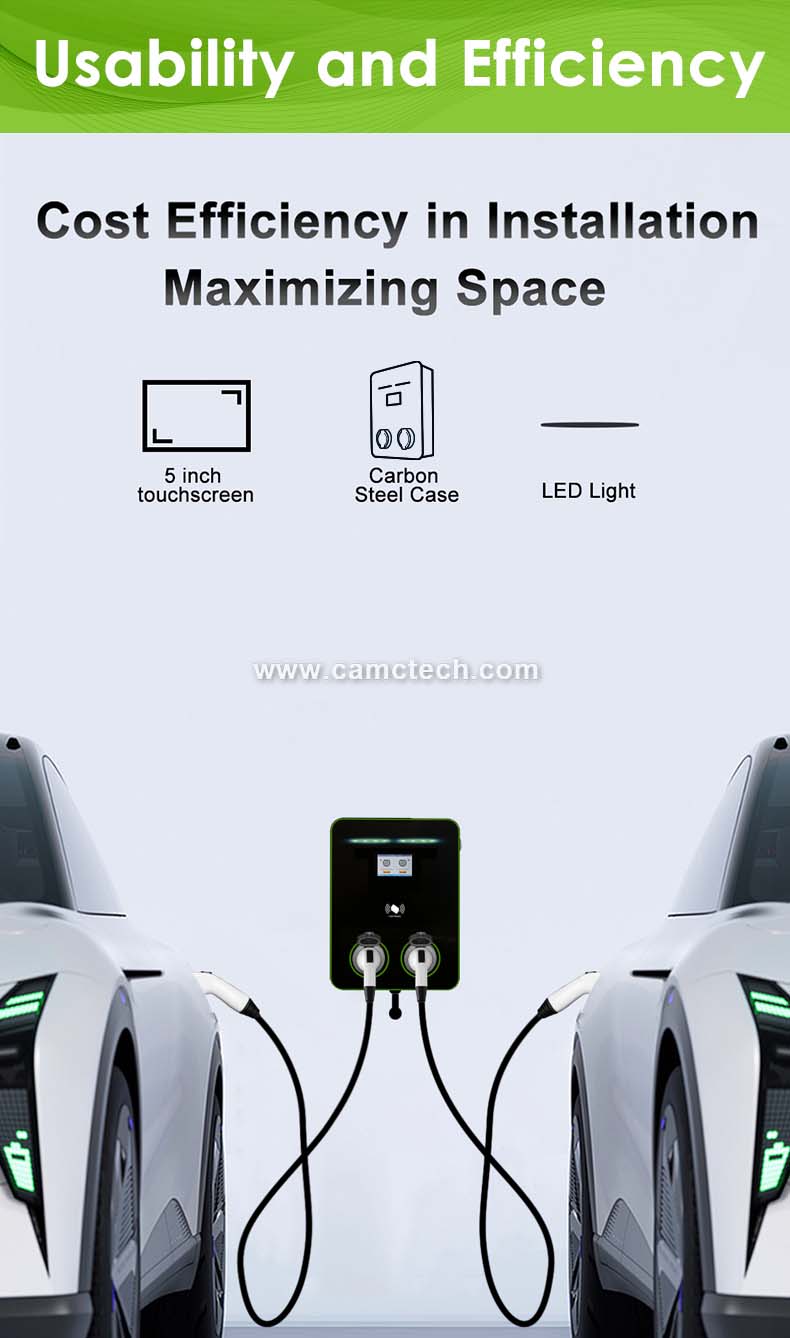
The indoor warehouse space is compact and the vehicles are parked neatly. Wall mounted charging piles or small floor standing DC piles are preferred, which do not occupy the driving channel, are dust-proof and oil proof, and are suitable for long-term stable indoor charging. Outdoor storage yards and parking areas have high levels of dust, large temperature differences between day and night, and frequent exposure to rainwater. Therefore, it is necessary to use IP55 high protection floor standing charging piles, which are sealed, corrosion-resistant, sun resistant, and rain and snow resistant, and are not afraid of complex warehouse conditions.
For fleets with flexible venues and varying numbers of vehicles, CAMC flexible group charging all-in-one machines are the optimal choice. The modular design allows for on-demand expansion, and new vehicles added in the later stage do not require overall equipment replacement. It adapts to the scale of fleet iteration and upgrades, significantly reducing the cost of secondary renovation.
3、 Adapt to special working conditions in the warehouse, enhance durability and protection performance
The fleet warehouse is different from ordinary charging sites in that it has long-term conditions such as dust, oil pollution, vehicle scratches, frequent start stop charging, etc. The durability of equipment is far more important than basic parameters. When making a purchase, it is important to pay close attention to the core configuration and prioritize the use of fully sealed waterproof modules that are dust-proof, moisture-proof, and resistant to oil erosion, in order to avoid module short circuits and downtime caused by harsh warehouse environments.
At the same time, the equipment needs to have the ability to operate at a wide temperature range, and be able to operate stably at full power within the temperature range of -25 ℃ to 50 ℃, adapting to the seasonal temperature differences in warehouses across the north and south. The body is made of thickened sheet metal material, which is resistant to minor vehicle collisions. It is equipped with multiple heat dissipation systems, and can be charged in batches for a long time without high temperature or power reduction, ensuring stable energy replenishment for the fleet all day long.
4、 Intelligent operation and maintenance management, adapted to fine control of vehicle fleets
The core demand for fleet charging is not only energy replenishment, but also unified control, energy consumption statistics, and cost accounting. Professional fleet warehouse charging stations must be equipped with an intelligent cloud management system that supports remote start stop, power regulation, automatic fault alarm, and charging data statistics. It can accurately record the charging amount, charging time, and energy consumption cost of each vehicle, facilitating fleet financial accounting and fleet management.
At the same time, it supports automatic adaptation of peak and valley electricity prices, and can set up scheduled charging for valley electricity at night, maximizing the reduction of fleet electricity costs. The CAMC fleet dedicated charging station supports multi account permission management, remote equipment operation and maintenance, and one click troubleshooting, without the need for manual on-site monitoring, greatly reducing the labor cost of fleet operation and maintenance, and adapting to the needs of fine management of large-scale fleets.
5、 Verify compliance and security, avoid long-term operational risks
Safety and compliance are the bottom line for the long-term operation of fleet charging stations. When purchasing, it is necessary to verify the complete qualifications of the equipment, have national standard certification, electrical safety testing reports, and be equipped with multiple protection functions such as overvoltage, undervoltage, overcurrent, short circuit, leakage, lightning protection, and emergency stop. The shell is made of flame-retardant material to eliminate electrical fire hazards and is suitable for warehouse personnel and vehicle intensive scenes.
At the same time, it is necessary to match the capacity of the warehouse transformer with the equipment to avoid blindly installing high-power devices that may cause overloading and tripping of the power grid. Priority should be given to selecting brand original equipment, with a complete after-sales network, spare parts reserves, and technical support, to quickly respond to faults and reduce the loss of work caused by fleet downtime.
Summary
The core logic for selecting charging stations for fleet warehouses is to determine the power of the vehicle model, the type of vehicle on site, the protection based on working conditions, the intelligence based on operation, and the compliance based on landing. Light vehicle fleets are compatible with small and medium power multi gun charging stations, while heavy truck fleets use high-power fast charging and flexible group charging equipment; Indoor wall mounted models are preferred, while outdoor floor standing models with high protection are preferred. CAMC's dedicated charging stations for the entire fleet are optimized and upgraded for warehouse dust, oil pollution, and centralized charging conditions. They combine efficient energy replenishment, intelligent control, and safety stability to create a low-cost, high-efficiency one-stop new energy replenishment solution for logistics fleets.